


Decoding the Market Shift: What National "Seller Motivation" Really Means for Coastal LA Real Estate
For months, national economic headlines have repeated the same script: housing is stuck in an affordability trap, elevated interest rates are freezing transactions, and home prices remain stubborn.
Recently, new real-time analytics from Parcl Labs—highlighted across national investment channels like BiggerPockets—suggest that "the ice is cracking." The national Motivated Seller Index (MSI) officially tipped into "motivated" territory, signaling that seller leverage across the country is softening.
While national data maps highlight where sellers are starting to blink, understanding real estate requires zooming in. What holds true in Sunbelt overbuild markets looks drastically different when applied to the coastal pockets of Pacific Palisades, Santa Monica, Venice, and the South Bay.
The Macro Picture: How Parcl Labs Tracks the Shift
Parcl Labs measures market pressure across three specific metrics:
-
Supply vs. Demand Skew: Tracking regions where active inventory expansion is outpacing buyer demand.
-
Price Reduction Velocity: Tracking how fast sellers are cutting list prices to capture active buyers.
-
Unrealized Loss Margins: Identifying areas where listings are settling noticeably below their peak comps.
Across Texas, Florida, and portions of the interior West, new residential construction and elevated carrying costs have forced sellers to adjust prices downward. Nationally, seller leverage is shifting toward buyers for the first time in years.
Micro Reality: Why Coastal LA Operates on a Different Frequency
While national seller indices capture broader macro trends, coastal Southern California operates under unique structural dynamics.
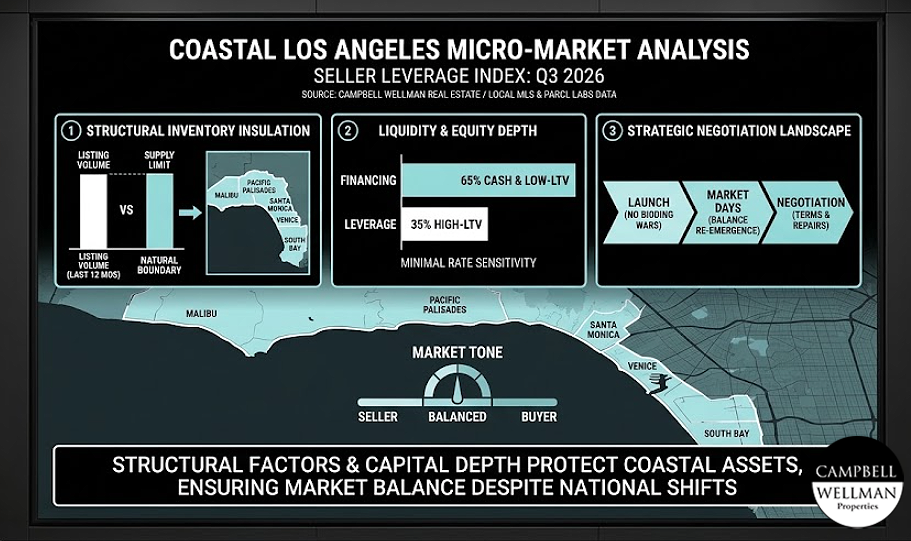
1. Structural Inventory Insulation
Sunbelt markets experiencing significant price cuts often face competition from continuous new construction. In contrast, coastal Los Angeles—from the Palisades down to Manhattan Beach—is geographically locked between the mountains and the ocean. Supply remains strictly finite. Even when buyer activity slows seasonally, listing volume stays tightly controlled.
2. Liquidity Over Leverage
The national Motivated Seller Index is heavily influenced by rate-sensitive buyers and leveraged inventory. In our primary Westside and South Bay micro-markets, a high percentage of transactions are driven by cash, private equity, or substantial equity positions. That capital depth prevents panic pricing.
3. Re-emergence of Strategic Buyer Leverage
While local sellers are not panic-cutting prices, buyer leverage has evolved. Sellers who overreach on launch pricing can no longer rely on immediate, unvetted bidding wars. Buyers now have space to negotiate terms, request property repairs, and secure price adjustments on inventory that sits past its initial 30-day window.
The Campbell Wellman Take
National real estate data is fantastic for spotting broad trends, but real estate is always local. While national headlines talk about sellers 'blinking,' on the Westside and South Bay, we are seeing a return to a balanced, rational market. Well-priced, high-quality properties in top-tier locations continue to sell quickly. For homes that launch over-market, buyers finally have the leverage to negotiate realistically.