


A Titan Departs: Honoring the Unbelievable Architectural Legacy of Frank Gehry (1929–2025)
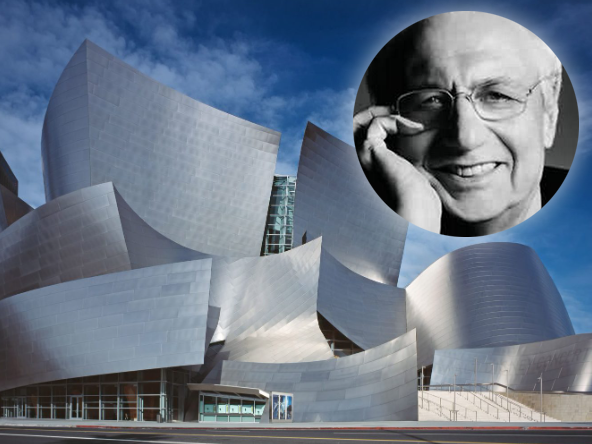
The world of architectural design lost a legend on December 5th, 2025, with the passing of Frank Gehry at the age of 96. A Canadian-American visionary whose creations transcended mere structure to become dynamic, living sculptures, Gehry leaves behind an almost unbelievable legacy that permanently reshaped city skylines and the very definition of architectural possibility.
For us in the Westside, this loss is deeply personal. Gehry was not just an international icon; he was our local icon, having called Santa Monica home, a base from which he launched his radical, globe-altering career.
From Corrugated Steel to Deconstructivism
Gehry’s architectural journey began in his own neighborhood, challenging the conventions of domestic design and setting the stage for the global movement known as Deconstructivism.
The Gehry Residence (Santa Monica, USA, 1978)

The radical extension to his own Dutch-style suburban home remains one of the most influential residential projects of the 20th century. Gehry wrapped the existing structure in a series of colliding, interlocking forms constructed from shockingly affordable materials: corrugated steel, chain-link fencing, and raw plywood.
This project made his name, proving that high design did not require "fancy materials," but fearless aesthetic choices. As Gehry noted, he was drawn to materials like galvanized corrugated metal for their inherent aesthetic value.
Early European Impact: Vitra & Weisman
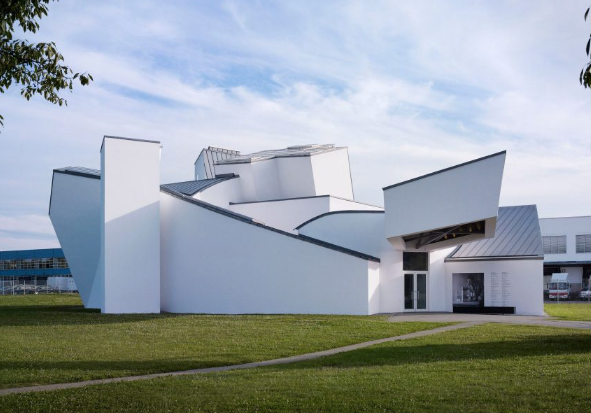
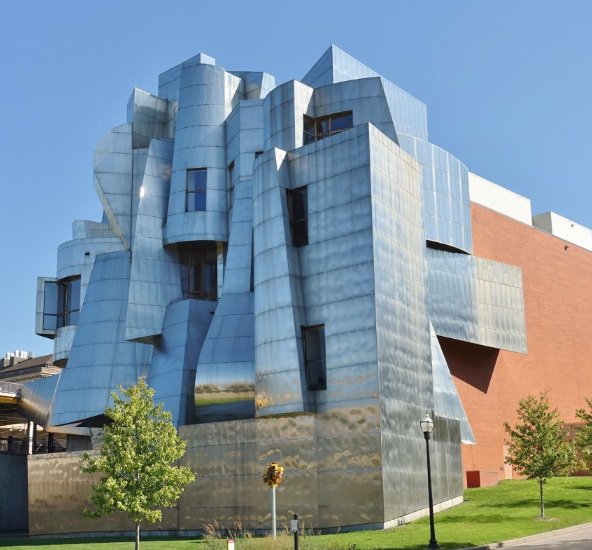
Gehry quickly moved from residential protest to large-scale cultural architecture. The Vitra Design Museum (Germany, 1989) was his first European commission, utilizing white plaster and a titanium-zinc alloy to create the highly sculptural style that would become his hallmark. He continued this exploration with the Weisman Art Museum (USA, 1993), featuring a split-personality design where curved, shimmering stainless steel faced the river, while brick blended the structure into the historic campus buildings behind it.
The Masterpieces: Transforming Cities Through Form
Gehry’s work in the late 90s and early 2000s achieved true global transcendence, demonstrating the colossal civic power of visionary architecture.
The Guggenheim Bilbao (Spain, 1997)
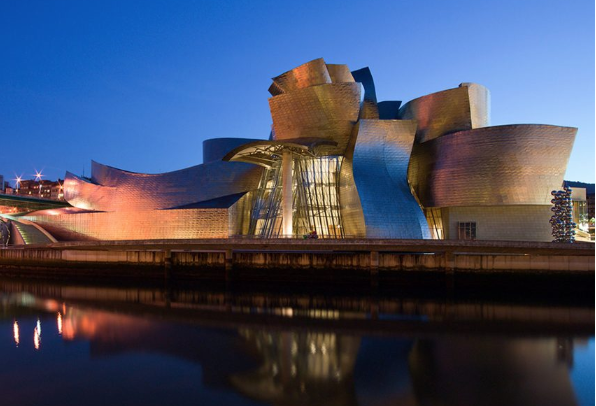
Arguably Gehry's most recognized and influential work, the Guggenheim Bilbao is a sweeping monument clad in swooping, fish-scale-like titanium panels. It was hailed as the most significant building of the Deconstructivist style. More importantly, the building transformed a declining industrial city, inspiring the worldwide phenomenon known as "the Bilbao effect," where cities sought to revitalize their fortunes through landmark architecture. Gehry simply stated, "I didn't mean to change the city, I just meant to be part of the city."
The Walt Disney Concert Hall (Los Angeles, USA, 2003)
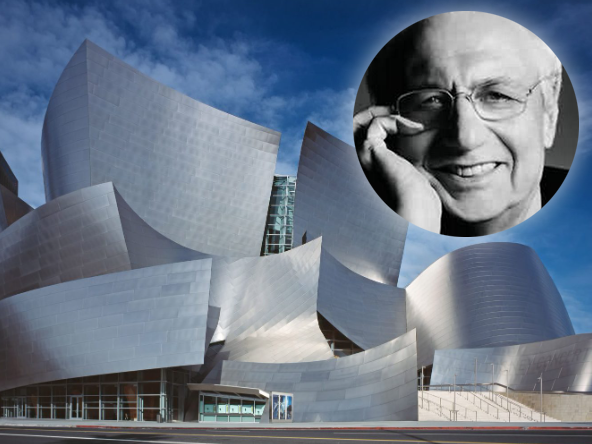
Los Angeles received its own signature Gehry masterpiece with the Walt Disney Concert Hall. A formal sibling to the Guggenheim Bilbao, its boisterous, curvaceous stainless steel sails inspired by Gehry's passion for sailing have become an indelible fixture of the downtown skyline and a cornerstone of the city’s cultural revitalization.
Gehry’s Enduring, Global Legacy
Gehry’s influence extended into virtually every architectural typology, from temporary structures to residential skyscrapers.
-
Residential Verticality: His first New York skyscraper, 8 Spruce (New York by Gehry) (USA, 2011), applied his signature crumpled, wave-like facade to a high-rise, creating unique living spaces and bay windows for its 903 apartments.
-
Later Cultural Landmarks: He continued to push boundaries with the Fondation Louis Vuitton (France, 2014), a pavilion covered in giant, complex curved glass shells, and the striking, stainless steel-clad Luna Arles tower (France, 2021).
His final major cultural building, the Guggenheim Abu Dhabi (UAE, reportedly opening 2025), promises to be a final, complex composition of curved metal sheets and jagged canopies, cementing his place in history alongside architectural giants.
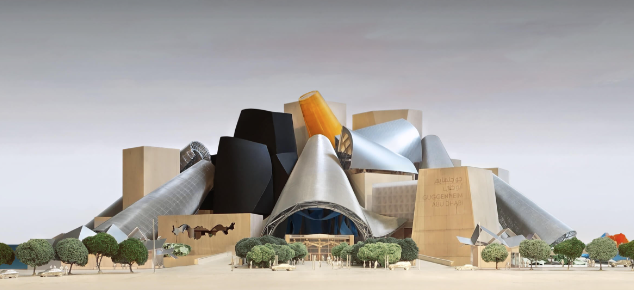
Frank Gehry was a force who liberated architecture from rigid conventions, blurring the line between building and sculpture. His adoption of aerospace-grade digital software to realize his complex, fluid visions irrevocably changed industry standards.
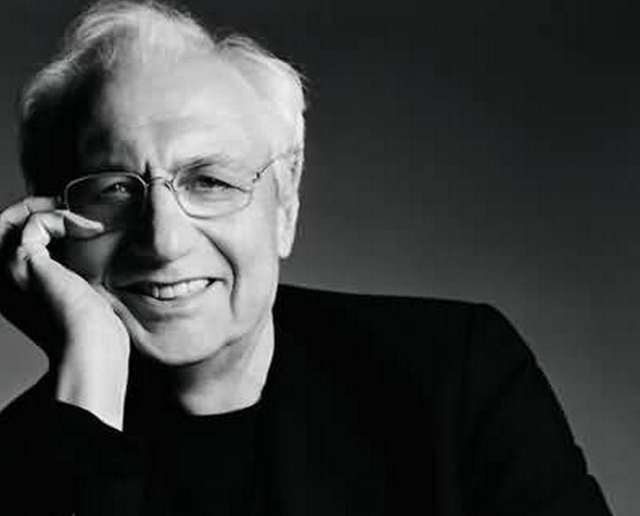
Campbell Wellman takes immense pride in the fact that this world-changing architect, who proved that genius can be built with humble materials and imagination, called Santa Monica home. His legacy continues to inspire us to see every property, whether a custom home or a commercial project, not just as a structure, but as a dynamic work of art.