


The "No Tax on Home Sales Act" and Its Market Impact

The real estate market, particularly within Los Angeles's Westside, consistently generates significant interest. Our community, known for its exceptional lifestyle, premier educational institutions, and desirable locations, has experienced substantial home value appreciation over many years. While this growth benefits homeowners, it has also created an unintended challenge under current federal tax regulations: an increasing number of long-term residents currently face considerable capital gains tax obligations when selling their primary residences.
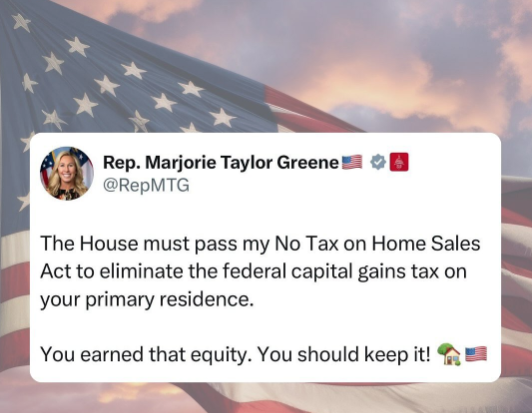
A recent legislative proposal, the "No Tax on Home Sales Act," was introduced in the U.S. House of Representatives. While the legislative path for any bill is intricate, this proposal seeks to eliminate the federal capital gains tax on the sale of a primary residence. Understanding the potential ramifications of such a change on our distinctive Westside market is crucial for homeowners, prospective sellers, and buyers.
The Current Situation: Extremely Outdated
Current law permits homeowners to exclude up to $250,000 in capital gains from taxation ($500,000 for married couples filing jointly) when selling their primary residence. These exclusion limits, however, have remained unchanged since 1997. Consider this scenario: A home in Pacific Palisades acquired for $800,000 two and a half decades ago could readily command $2.8 million today. This represents a capital gain of $2 million. Even with the $500,000 exclusion for a married couple, $1.5 million of that gain would still be subject to federal capital gains tax. At a typical 20% federal long-term capital gains rate (which can be higher for certain high-income earners), this equates to a $300,000 tax liability.
This substantial tax burden can deter long-standing homeowners – particularly seniors or those contemplating downsizing – from listing their properties. They may feel financially constrained to a residence that no longer aligns with their needs, solely to avoid a significant tax payment.
The Proposed Act's Potential for the Westside: Concrete Advantages
The "No Tax on Home Sales Act" aims to remove these monetary limits entirely for primary residences. If enacted, the entire capital gain from the sale of your primary home would be federally tax-exempt. This provision would not extend to secondary homes, investment properties, or speculative transactions. For our Westside market, the potential positive outcomes are noteworthy:
-
Enhancing Inventory and Promoting Mobility: Many homeowners have expressed hesitation to sell due to the impending tax obligation. Eliminating this tax could encourage these homeowners to list their properties, potentially increasing the housing supply in highly sought-after areas like the Westside. A rise in available homes, especially from long-term owners, could revitalize the market with fresh inventory.
-
Illustrative Example: Even a modest 5% increase in annual sales across the Westside (e.g., an additional 100-150 homes per year) driven by this newfound financial flexibility would considerably broaden options for buyers and ease some of the pressure in our often supply-constrained market.
-
Substantial Tax Relief for Long-Term Homeowners: The most direct benefit is the considerable tax savings for homeowners who have accumulated significant equity. Reverting to our earlier example, the Pacific Palisades couple with a $1.5 million taxable gain could potentially save $300,000 in federal taxes. This is a life-altering sum that could be reinvested, utilized for retirement, or allocated towards a new residence.
-
Community Benefit: This empowers homeowners to make housing decisions based on personal circumstances, rather than tax considerations. A senior couple could comfortably downsize without a massive tax impact, making a larger family home available for a younger generation.
-
Potential for Housing Accessibility & Market Fluidity: While economists hold differing views, some proponents suggest that encouraging more sales could help stabilize or even moderate home prices over time, benefiting first-time buyers who face challenges in competitive markets like ours. A greater supply allows for more choices and potentially less intense bidding.
-
Market Cycle Revitalization: A consistent flow of homes, facilitated by this tax relief, fosters a healthier market cycle where more individuals can enter and exit homeownership with greater ease.
Considerations and the Broader Context
It is important to acknowledge that, like any significant policy proposal, this bill is subject to scrutiny. Among various concerns raised, some economists debate the precise impact on overall housing supply or prices, or if it could potentially stimulate demand further.
Nevertheless, for the Westside, where substantial equity gains are common and housing mobility can be a hurdle for long-term owners, the "No Tax on Home Sales Act" presents a compelling possibility. It holds the potential to remove a major financial impediment for many, fostering more natural market dynamics and offering significant tax relief to those who have contributed to and sustained our communities for decades.
As we continue to monitor the progress of this important proposal, we at Campbell Wellman believe it is essential for homeowners and prospective buyers to comprehend its potential implications. Policies such as this, if enacted, can profoundly reshape real estate decisions on the Westside.
Interested in how potential tax changes could influence your specific real estate objectives on the Westside?
Connect with Campbell Wellman today for a personalized consultation.